Outcome-based Digital Roadmap
Our services
Create a product vision and strategy
What is the challenge you're responding to? Set a North Star to align people on the mission and the levers that will be used to guide you there. To both move fast and build the right thing, you need context, not control.
See how we can help
Discover what your users actually want
What does your audience need? In pursuit of the North Star, you need to figure out how to meet your users' needs (Jobs to be Done) and the capabilities you need to do so (service blueprint mapping).
See how we can help
Build an outcome-based digital roadmap
What do you do next, and how do you share progress? Set priorities, transparency and accountability, performance management, and communicate those things too.
See how we can helpFoundations
Learn what a Digital Roadmap is and how it is essential to clarifying and accelerating your digital-first strategy.


Solving HIEs revenue and adoption challenges with service design
Service design can help HIEs increase patient adoption and unlock value-driven revenue streams. In this article, we discuss three service design principles for HIEs to consider for their strategy and operating model to ensure user-centricity and accessibility.
Align Product Strategy
Leading clients to clarity with the North Star framework
At Rangle, our motto is building the right thing, the right way. But if doing that was as easy as saying it, our client companies would never need our help.
Align Product Strategy

Designing your customer-centric transformation
Check out Rangle's on-demand webinar to learn exactly what a Design System is and how it can help build the future of your business.
Scale Design

Lean Discovery: Shifting from Outputs to Outcomes by Finding & Fixing Customer Pain
So many software development projects start with high levels of uncertainty. Some of it is explicit, you many not know exactly who the target customer is and what they want, and some of it may be implicit, you have a great idea but are uncertain about the technical risks of delivering the experience or what the state-of-the-art is capable of and, as they say, you don't know what you don't know. In these cases we echo the words of "Ike" Eisenhower:
Align Product Strategy
What 'Customer Centric Design' Really Means
In a nutshell, a customer-centric approach to design is about realizing that what you're creating is not about what you think it should be. It's about what somebody else, the customer, needs. It's also a way to ensure that you're anticipating customer needs based on an understanding of the user's journey—meet them where they are.
Align Product Strategy
The role of purpose in digital (Hint: It's everything)
Purpose is not new. It was first referenced in the 14th century, and even the ancient philosophers had a crack at defining the purpose of life: The pursuit of knowledge (Plato), or creating a plan for 'living well' (Aristotle). But Simon Sinek's 2009 book,
Align Product Strategy
How an outcome-based Digital Roadmap dramatically improved Staples solution builder app
Learn howMore resources
Rangle's Product Strategy Playbook
A collection of guides and templates for prodcut managment and service design mapping.
Learn more
Related expertise

Operating Model
Product & Platform Operating Model
Align teams around a product and platform model that supports real delivery speed.
See how we help
New Product Development
Product Development
Launch new products with a traction-first approach to discovery, delivery, and growth.
See how we helpNeed a digital roadmap?
We help enterprises find the fastest path from strategy to production.
Get in touchRelated case studies

MoveBuddy
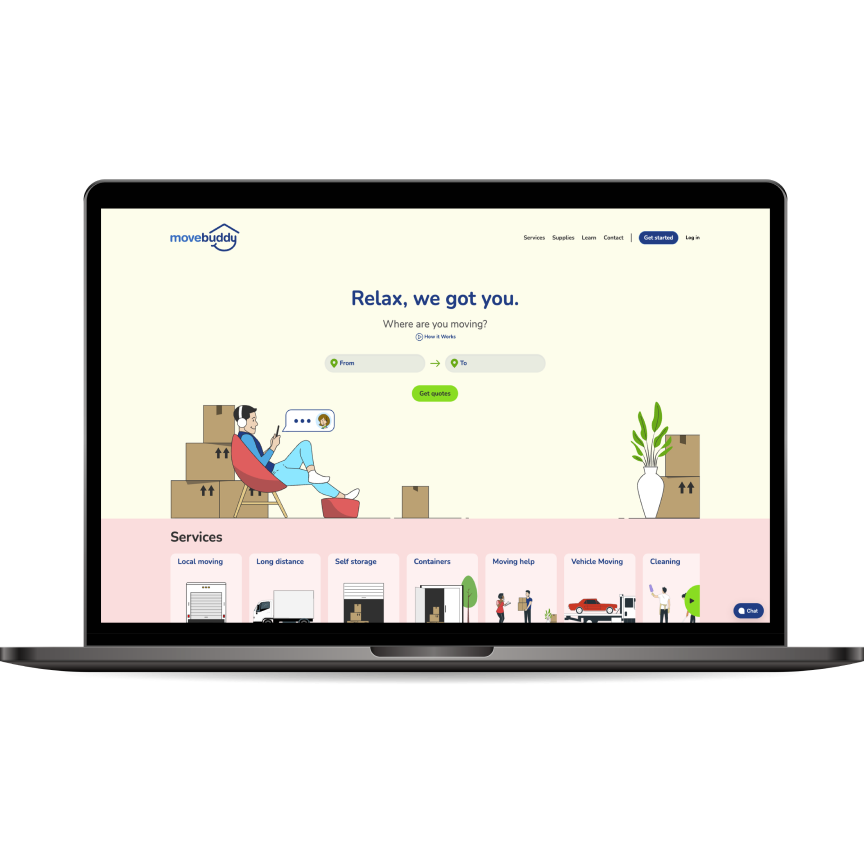
Marketplace finds path to product-market fit in months, not years
Rangle and Movebuddy were able to build a marketplace and innovate on its business model in a matter of months, not years.
Case Study
How we helped a leading office supply retailer build their digital roadmap in 8 weeks
We guided a leading office supply retailer to build their digital roadmap in 8 weeks.
Case Study

WeSwap
WeSwap x Rangle: Remote discovery for the new digital-only workplace
WeSwap was expanding their original offering of a prepaid travel currency card to further their user reach.
Case Study

Greenbridge
Building a modern tech stack for greater control and user experience
We built an open-source, scalable platform for Greenbridge Foodservice, allowing them to focus on strategy and creating great customer experiences.
Case StudyFrequently Asked Questions
An outcome-based digital roadmap is a strategic plan that ties product development directly to business outcomes rather than feature lists. Instead of planning "build feature X by Q3," it frames work as "increase customer self-service completion rate by 40% by Q3," then identifies the product changes needed to achieve that outcome. Rangle's approach grounds product vision in understanding business goals, market trends, and customer needs, then establishes metrics to track progress. The result is a roadmap that gives stakeholders transparency into what's being built and why, creates accountability for results rather than output, and can adapt as market conditions change without losing strategic direction.
Jobs-to-be-Done (JTBD) is a research framework that identifies what customers are actually trying to accomplish, not what features they say they want. Rangle uses JTBD to uncover the triggering events, underlying motivations, and desired outcomes that drive customer behavior. Through customer interviews, surveys, and data analysis, we map the "jobs" your customers hire your product to do. This prevents the common mistake of building what stakeholders assume customers want rather than what customers actually need. The framework is particularly valuable for digital transformation initiatives where organizations are rethinking their product portfolio. It ensures new digital investments solve real problems rather than digitizing existing processes that may themselves be flawed.
A typical digital roadmapping engagement takes 4-8 weeks, depending on scope and organizational complexity. The first 1 to 2 weeks focus on discovery: stakeholder interviews, customer research using Jobs-to-be-Done methodology, market analysis, and current-state assessment. The next 2-3 weeks develop the roadmap itself: defining the product vision, identifying outcome-based milestones, establishing success metrics, and creating the communication framework for stakeholders. For larger organizations with multiple product lines or business units, the process may extend to 10-12 weeks to ensure cross-functional alignment. The deliverable isn't just a document. It's a living planning tool with clear metrics, prioritization criteria, and governance processes for ongoing updates.
A project plan defines tasks, timelines, and resource allocation for a known scope of work. A digital roadmap operates at a higher level: it defines strategic direction, outcome-based milestones, and decision criteria for an evolving portfolio of work. Project plans answer "how do we build this?" Digital roadmaps answer "what should we build and why?" The distinction matters because digital transformation is inherently uncertain. A rigid project plan breaks when assumptions change. An outcome-based roadmap adapts because it's anchored to business outcomes, not specific features. When market conditions shift or customer research reveals new insights, the roadmap's milestones stay relevant even as the specific initiatives underneath them change.
Effective digital roadmapping requires input from three groups: business leadership (who define strategic goals and constraints), product and technology teams (who understand feasibility and technical debt), and customer-facing teams (who know what users actually experience). Rangle facilitates this cross-functional alignment as part of the engagement. We've seen too many roadmaps fail because they were created by one group in isolation. The process typically involves 8-15 stakeholders across these groups, with structured workshops and interviews designed to surface conflicts early rather than discovering them during execution. The goal is a roadmap that everyone has contributed to and can commit to, not a top-down mandate that teams resist.
From the blog
Leading clients to clarity with the North Star framework
At Rangle, our motto is building the right thing, the right way. But if doing that was as easy as saying it, our client companies would never need our help.
Align Product Strategy

Avoiding the temptation to be everything to everyone: Key goals of product strategy during Product Scaling / Growth
Do you remember the last time you had a conversation about a newly popular product that seemed to have started losing its way? Maybe it was a new snack that tasted a little different as its ingredients adapted to mass production requirements, or a once-niche home improvement tool that now seemed
Align Product Strategy
The parallel path: Moving forward with a new technology solution when business strategy is in flux
For many scale-up companies, digitizing their business model has become the top focus in the one year since COVID-19 created the biggest disruption to our economy of the century. These new challenges required new ways of thinking and doing, and a reassessment of whether their digital experiences were serving customer needs in optimal ways.
Modernize Your Stack