


How Fortune 500 Companies Lose Millions on Failed Agile Transformations
Enterprise digital transformations have a high failure rate. After years of helping organizations implement scaled agile frameworks, we've identified a critical pattern that explains why so many enterprise transformations fail: organizations skip the essential "Product Definition" phase, jumping directly from vision to execution.
Design teams create beautiful mockups without knowing if they solve real problems or deliver business value. Tech leads demand high-fidelity designs rather than co-creating solutions with product and design teams. Business stakeholders risk launching something that won't deliver value or wasting months starting over. Transformation initiatives fail to deliver ROI.
Where Traditional Agile Falls Short at Scale
Most agile methodologies assume certain conditions: clear product ownership, established architecture, and teams that understand their domain. But in enterprise transformations, these assumptions rarely hold.
What actually happens:
- Multiple stakeholders have competing visions that were never reconciled
- Architecture decisions get deferred until they become blockers
- Teams inherit vague mandates like "modernize the customer experience"
- Design and development operate in parallel universes, occasionally colliding in spectacular fashion
Development needs better designs. Design needs clearer requirements. Product needs more stakeholder alignment. Stakeholders need to see progress. Nothing ships.
Product Definition Framework for Enterprises
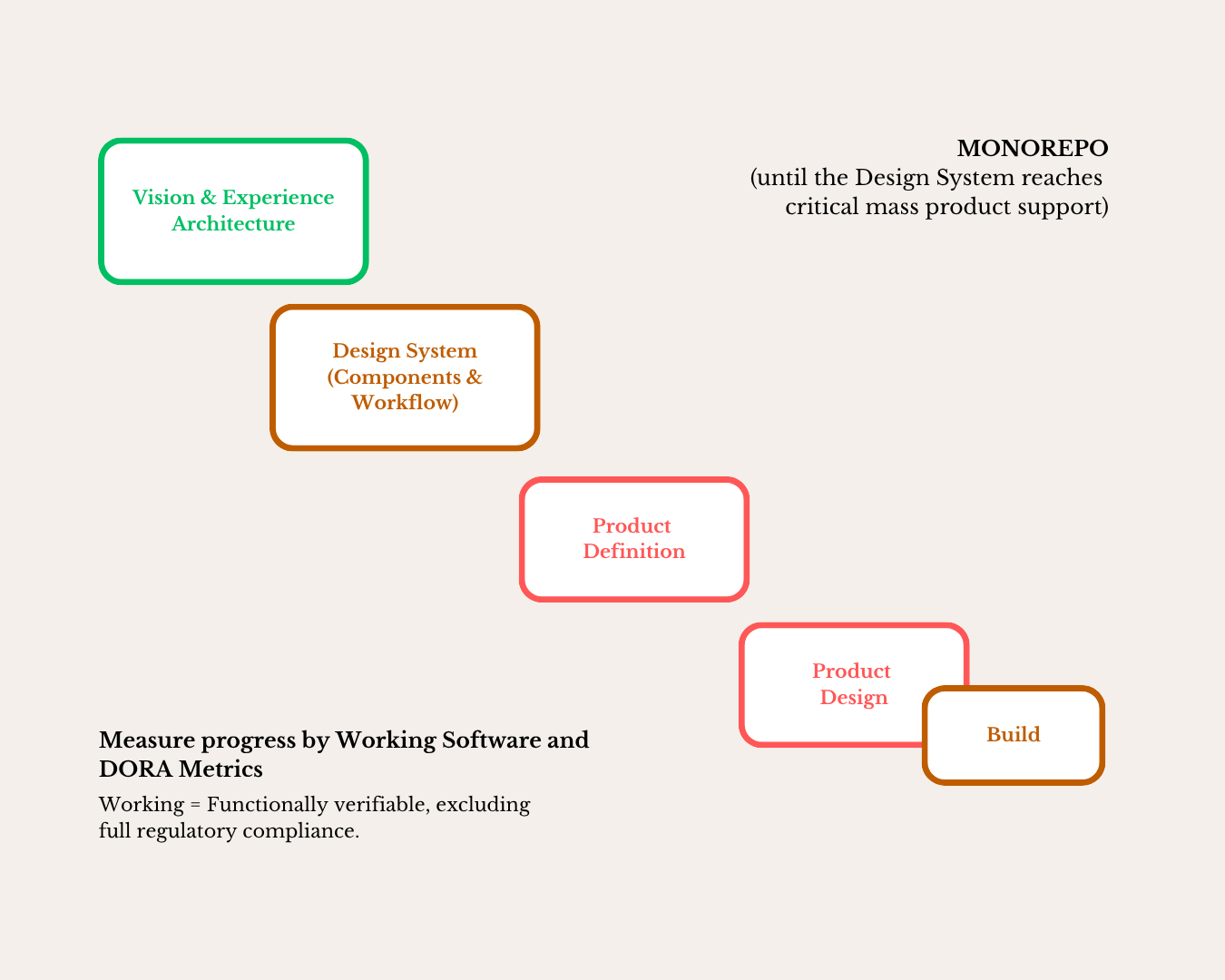
Product Definition is a dedicated phase that sits between high-level strategy and detailed design. Think of it this way: your executives have a vision ("modernize our customer experience"), and your designers need to create specific interfaces and workflows. That gap between these two levels of thinking kills transformations.
Product Definition bridges it through working prototypes, user journey maps, and technical experiments. You build an ugly but functional payment flow to validate that it is actually possible to connect to your ancient billing system. You map user journeys on a wall where everyone can see them, argue about them, and fix them so everyone is invested in the pain points your customers go through. You test whether customers can find anything in your proposed navigation before designers waste weeks polishing the wrong thing.
The key outcomes are shippable increments, architectural confidence, and system clarity.
The Five Core Deliverables
Product Definition produces five interconnected outputs, each addressing specific organizational gaps:
User Story Maps: Not a backlog with 200 disconnected tickets. Instead, a visual map on the wall showing what users are actually trying to do. You can point to it and say "this is the happy path" or "this edge case breaks everything." Everyone is working from a place of shared understanding, rooted in your customer. Arguments happen early when they're cheap, not during development when they're expensive.
Prototypes: Functional code that allows you to validate your core assumptions and risks. Can our search actually handle a million products? Does this workflow make sense to actual users? Will this integrate with that legacy system nobody wants to touch? Working software becomes the validation mechanism, not requirements documentation.
Information Architecture: The structural foundation defining how your system organizes and relates information. This goes beyond navigation menus—it's how data flows between services, how different parts of your system connect, and whether your platform will scale or become another legacy monolith. It answers questions like: How do products relate to orders? Where does customer data live? How do services communicate?
Experience Architecture: The coherence layer that prevents your customer experience from fragmenting across channels. It defines not just individual touchpoints but how your web portal, mobile app, call center, and email communications work together as a system. Without this, you get the typical enterprise experience where customers have to re-explain their problem to every channel.
Way of Working Documentation: How does the team move forward when design says one thing and tech says another? What happens when the product owner is on vacation? When do architects get to veto decisions? You document these answers because otherwise every decision becomes a meeting, and every meeting becomes a power struggle.
Why This Actually Works
Product Definition addresses a fundamental problem in software development: cognitive overload. When teams try to simultaneously understand the problem space, design solutions, and build systems, performance degrades predictably.
Consider what happens without Product Definition:
- Developers code while holding incomplete mental models of the system
- Designers create interfaces for workflows they have a partial understanding of
- Architects make decisions without knowing the implementation constraints
- Product owners prioritize features without grasping technical implications
Now add Product Definition:
- Developers work from validated prototypes and clear architectures
- Designers build on established patterns and information structures
- Architects base decisions on proven technical experiments
- Product owners see working software before committing resources
The result? Teams achieve up to 2X velocity when the cognitive load shifts from "figuring out what to build" to "building what's been figured out."
Building Systems That Scale
Begin with defining component boundaries before they're built. This means determining which services own what data, how they communicate, and what their responsibilities are—before you have legacy code making these decisions irreversible.
Product Definition also establishes your design system foundation. Not just a component library, but the systematic approach to building interfaces that ensures consistency across teams and products. This prevents teams from building the same dropdown six different ways.
The monorepo and design system together form what we call the "0 to 1 platform foundation", or the minimum viable structure that prevents divergence. Without this foundation, every team solves the same problems differently, and integration becomes a nightmare.
Scaled Agile Meets Agentic Development
The same principles that make Product Definition essential for scaled agile success also lay the groundwork for agentic development practices. Both require:
- Context Provision: Clear understanding of the problem space before solution design
- Cognitive Load Reduction: Breaking complex systems into manageable chunks
- Incremental Validation: Testing assumptions through working software
- System Clarity: Maintaining architectural coherence as complexity grows
Teams with strong Product Definition adopt AI tools faster and more effectively because they have the structural clarity AI needs to be helpful. By solving your failed agile practice, you're simultaneously building the foundation for successful agentic development.
Moving Forward
While no single framework works for every organization, the Product Definition phase represents a non-negotiable element for successful digital transformations. Without it, teams will continue the cycle of blame, confusion, and failed deliveries.
The validation process shifts from requirements documentation to working software, creating a feedback loop that builds confidence and clarity.
By recognizing and implementing this missing phase, organizations can finally break the pattern of transformation failures and achieve the velocity and quality they've been seeking all along.


